
Cherokee Crime News Has No Sheriff Feed
Don't expect a sheriff's crime feed here. The county detention page has an Inmate Search control. The link goes nowhere usable at present, and the older sheriff entry point was no better. There is no official roster of booking fields, photos, or update schedules to check a news story against.
The practical route shifts to phone calls and court dockets. For current custody questions, call the Cherokee County Detention Center directly. It holds county and local inmates awaiting trial or serving short sentences. Once you have a name, a rough date, or a case number, move to the official court sources for the later case. Cherokee County's detention-center page gives facility details and contact numbers. It is not a live mugshot or news feed.
Cherokee Crime Coverage Is Story-Driven
The Gaffney Ledger, listed in the South Carolina Press Association directory, covers the county through individual stories rather than a standing booking blotter or photo gallery. One arrest report tells you about one event. It will not give you the full custody list or a timetable for every busted name in Cherokee.
FOX Carolina runs regional incident coverage touching Gaffney and the surrounding area, sometimes with visuals tied to a specific story. None of it amounts to a county mugshot archive. The Cherokee Chronicle appears in county planning material as a local paper, but no verified blotter or crime section surfaces for it, so assume no regular arrest listing exists.
Together these outlets may report on Gaffney, Blacksburg, or countywide events. Treat them as journalism, not as confirmation of custody or case outcomes. A headline can start a records search. It should never end one.
Cherokee News Sources and Limits
The type of source decides what it can prove. Official custodians come first, since they answer for the jail and the court file. News outlets report events as they happen. Private booking-style indexes sit last: they go stale, they miss cases, and they settle nothing about current custody or an outcome. None are linked here.
| Source | What research supports | What it does not establish |
|---|---|---|
| Cherokee County Sheriff and detention source | Facility context and official contact route. | A verified crime feed, public roster, booking-photo policy, or daily arrest list. |
| The Gaffney Ledger | Event-specific local reporting. | A daily jail census or standing mugshot gallery. |
| FOX Carolina | Regional, event-specific Cherokee and Gaffney coverage. | A routine Cherokee booking archive or custody confirmation. |
| The Cherokee Chronicle | Countywide newspaper identified in County planning material. | A verified public crime, blotter, or mugshot section. |
| Private county-labelled indexes | A possible lead requiring official verification. | Present custody, identity, charge accuracy, completeness, or final disposition. |
A story that names the arresting agency gives you a useful lead. It does not make the publisher official. Your next stop depends on the question. Local custody means the jail. An incident report means the police. Anything about a hearing or verdict means the court.
Cherokee Mugshot Publication Is Unverified
No official Cherokee roster screen or booking-photo policy exists online to inspect. So there is no basis for claiming the Sheriff hands images to the press on a schedule or keeps a web archive. A photo in one story belongs to that story. Nothing more.
South Carolina law sets the public-record framework and includes a separate publication-and-removal statute for booking records. That statute promises no photo releases from Cherokee. It certainly does not bless a private page as official. The agency holding the record and the court running the case remain two different doors.
Check secondary indexes only after official sources. When such sites call a record "recent," that timing is their own claim, not a Sheriff schedule. Never lift a name, charge, photo, or date from one and present it as proof of custody or a case result.
Cherokee News Stories Need Court Follow-Up
Think of a news story as the first breadcrumb. The official chain still has to be walked. Cherokee's missing local roster makes the court leg even more important, since a person named in a report may be held, released, charged, or done with the case entirely by the time you read it. Court records supply that next judicial layer after the headlines fade.
- Note the name, reported incident date, arresting agency, and any case number without treating a news account as a final record.
- For a current local custody question, contact Cherokee County Detention Center at 864-487-2529. The public web control does not provide a verified roster result.
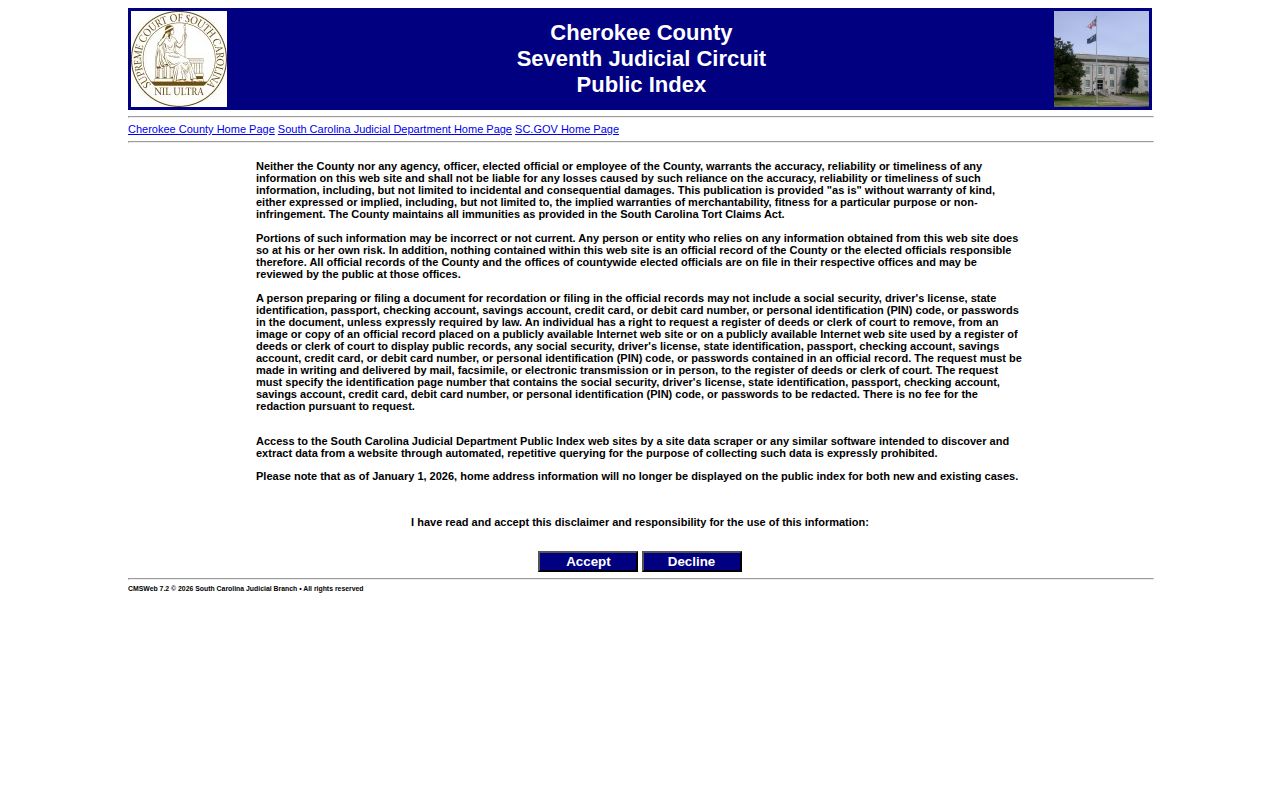
- Use Cherokee Public Index to look for the appropriate court case, then compare the parties, case number, and docket details before relying on a match.
- Check Cherokee court rosters for scheduled proceedings when relevant. A scheduled hearing is not a disposition.
- Read the later docket activity for the legal result, which may differ from the charge first described in a news report.
Cherokee Public Index is the official case-search route for the county. Use it to see past the initial story. Note: it covers court records, not live custody.
Cherokee Booking Charges Are Not Outcomes
A booking marks one intake event. It is a single entry, not a final word. The Cherokee County Solicitor handles Seventh Circuit criminal work in Cherokee and Spartanburg, spread across Circuit, Family, and Magistrate courts. Knowing the court division matters when you follow a case. A person may leave the county facility while the matter is still open. Charges can shift as things move through the system too.
- Booking
- Local intake after an arrest or detention event. It is not a finding of guilt.
- Charge
- An charge made in the criminal process. It may later be changed or dismissed.
- Disposition
- The court’s later resolution, such as a dismissal, plea, acquittal, conviction, diversion, or another outcome.
- Court roster
- A schedule of court matters, not a current jail census and not proof of a result.
A booking reference only opens the file. The docket, and the court's final action, tell the rest of the Cherokee County story.
Cherokee Court Records Continue the Story
Court records pick up where an arrest report leaves off. The official Cherokee Public Index is the place to start, since it lists filed matters and their docket activity. Court rosters add hearing schedules on top of that. Neither tool is a warrant portal or a jail roster, though, and a shared name alone proves little. Match the case details with care before you call a record a match.
Search with the strongest identifier you have. Verify the parties first. The Cherokee County Solicitor handles Seventh Circuit criminal work across Cherokee and Spartanburg, spread over Circuit, Family, and Magistrate courts, which is why the division, the case number, and later docket events matter more than a headline's shorthand. Hearing dates shift. Cases also keep moving after someone leaves county custody, so a docket check can turn up events the first story never mentioned.
For the wider picture, the Cherokee County record paths keep three things distinct: facility contacts, court follow-up, and state-prison custody. That separation matters. Without it, a later court entry or a state-corrections profile can be misread as a fresh local arrest report.